NMN vs NR: ingredients behind the NAD+ results
The letters look like competing entries on a shelf. The useful comparison starts with what each study actually gave its participants.
NAD+ vs NMN: precursor chemistry
NMN and NR are precursors: cells can use them to manufacture NAD+. NR is converted to NMN along the way. The NAD+ metabolism review sets out that chemistry; the human ageing review brings it into the supplement trials.
Counting biochemical steps gives NMN an appealing head start on paper. A shorter sequence on paper tells us little about the size of a useful human effect. Absorption, tissue handling and the outcome being measured all intervene. NR has the larger human trial history in this record; neither ingredient has established superiority for lasting health gains.
Nicotinamide riboside blood results
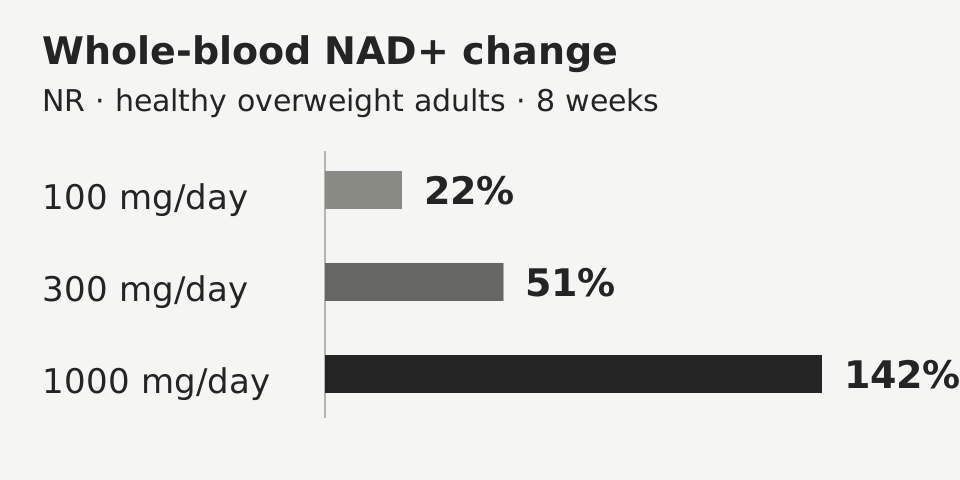
The NR study in healthy overweight adults ran for 8 weeks. Participants received 100, 300 or 1000 mg/day. Whole-blood NAD+ rose by 22%, 51% and 142%, respectively. The chart preserves those pairings. These are study amounts, with a particular population and duration attached.
No flushing was reported, adverse-event rates did not differ significantly from placebo, LDL cholesterol did not rise, and the measured markers of one-carbon metabolism were undisturbed. That last phrase concerns the handling of chemical units used in cell maintenance. I appreciate how concrete those safety observations are. Their reach ends with the checks and period studied.
NMN study outcomes
In the multicentre NMN trial, participants received 300, 600 or 900 mg/day for 60 days. Blood NAD+ was higher than placebo at days 30 and 60, walking distance improved, and no safety issues were reported. The authors identified 600 mg/day as optimal for that trial’s blood response. That is a judgement within the experiment; a personal treatment amount requires a different assessment.
The 250 mg/day NMN trial in postmenopausal women with prediabetes asked a more focused metabolic question over 10 weeks. Muscle insulin sensitivity improved while body composition and HbA1c stayed unchanged. Those outcomes deserve to travel together whenever this trial is discussed. The muscle page spends more time on why that combination matters.
The enzyme crystal study
A less conspicuous paper helps explain how NR can enter NAD+ production. In the structural study of nicotinamide riboside kinases, researchers examined human enzyme structures and tested enzyme activity in yeast. The work showed how the enzyme accommodates substrates on the route from NR toward NAD+.
The pleasure of this paper, for me, is its physical detail. An enzyme has a shape, and the interaction can be investigated. Human treatment outcomes still have to be measured in human trials.

Choosing a comparison
Separate trials supply the figures above. Their populations, durations and outcomes differ, so their results leave the NMN-versus-NR health comparison open. The 2025 review describes consistent blood increases alongside limited clinical efficacy.
A direct comparison could follow both ingredients through to the same useful outcome in the same kind of participants. The current record supports a narrower conclusion: both can raise blood NAD+. Study amounts and side effects have their own page, because a larger blood response also leaves questions about safety and duration.